Your Year in Moods: A 20-Minute Year-End Review From Your Data
The MoodKit Team
· 5 min read

Every December, Spotify tells you what you listened to, with a confidence that makes the year feel understood. Wrapped usually lands in the first week of the month, and for a day everyone knows their top artist and their minutes. Then they go back to not knowing what made them happy.
You can do better than that with a mood tracker and twenty minutes. Not a highlight reel; a review, with questions that have answers in your own data, and one or two things to carry into January that you’ve already tested. This is the agenda we use. (Disclosure: we build MoodKit, the tracker whose screens are named below; the questions work with any app that ranks activities and compares months.)
Why December beats January for this
Resolutions are made in January from memory, and memory is a bad analyst. It over-weights the last two weeks, it remembers the dramatic days and forgets the ordinary ones, and it has no idea what your average Tuesday felt like in April. A tracker does. Doing the review in December, before the resolution season, means the January list comes from evidence instead of guilt.
It also fits the calendar. If you ran a Winter Arc from October, its verdicts are in. If the holiday tags are set up, the December data is arriving as you read.
The 20-minute agenda
| Minutes | Question | Where the answer is in MoodKit |
|---|---|---|
| 0 to 3 | What did the year look like? | Year in Pixels: twelve months in one color grid |
| 3 to 6 | Which month was best, and which worst? | Monthly comparisons (30+ entries) and the year trend chart |
| 6 to 10 | What reliably lifted me? What dragged? | Impact Leaderboard, and the catalysts and triggers report |
| 10 to 13 | Did a weekday pattern hold all year? | Weekly Rhythms |
| 13 to 16 | What did I try that actually worked? | Your completed self-experiments and their verdicts |
| 16 to 20 | What do I carry into January? | A note in the app, or the CSV export |
Facts checked September 2026.
Minute by minute
The grid first. Open the Year in Pixels and don’t analyze yet, just look. Where are the dark clusters? Where does the color warm up? Most people can name the reason for each cluster within seconds, which is the point: the grid turns a year into a shape you can react to. The Year in Pixels guide covers how to read it properly, including the trap of judging a whole month by one bad week.
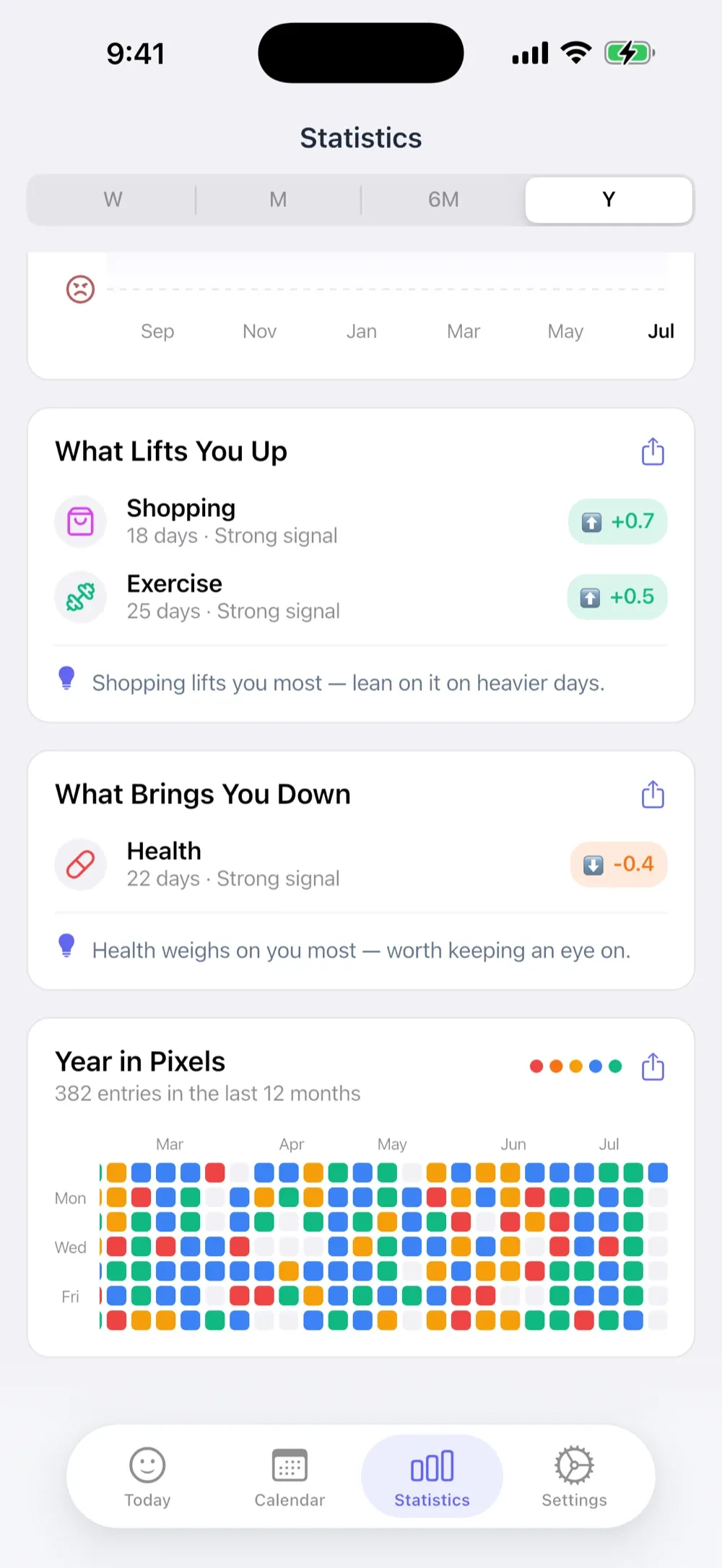
Best and worst month. The monthly comparison puts numbers on what the grid suggested. Write down the best month and the worst, and, more usefully, what was different: a job, a season, a relationship, a habit that started or stopped. The worst stretch is the more valuable of the two; it’s where next year’s protective habit comes from.
The leaderboard. This is the part memory can’t do. The Impact Leaderboard ranks every activity you tagged all year by its measured effect on your mood, with day counts, and at 30 entries the catalysts-and-triggers report names the strongest in each direction. Read the top three and the bottom three. Expect one surprise in each list. That surprise is usually the most important finding of the review, because it’s the thing you’d never have resolved to change.
The weekday pattern. Weekly Rhythms shows the day-of-week shape of your recent weeks. If Sundays or Mondays sit low all year, the Sunday scaries guide is next; if one weekday is oddly good, ask what’s in it and whether it can be moved.
The experiments. Every self-experiment you ran this year ended in a verdict from your own data. List the ones that came back positive. Those are the habits that have earned a permanent place, and they’re the only resolutions with evidence behind them.
What to carry into January
Two things, not ten. One catalyst to protect: the activity at the top of your leaderboard, scheduled into the week on purpose, especially in the weeks that were dark on the grid. One trigger to test: the strongest drag from the bottom of the list, run as a skip-a-habit experiment in the first week of January so the year starts with a verdict instead of a vow.
Everything else can wait. If the review produced more than two ideas, keep the list in the app’s notes or in the CSV export, and pull from it in February, when the first two are either habits or abandoned.
If you didn’t track this year
Then this review is a plan rather than a look back, and it takes fifteen seconds a day from here. Two months of entries by the end of the year is enough for a leaderboard and a first monthly comparison, which makes January’s review possible; a full grid needs the full year, so the one you’d be building now is December 2027’s. Logging in MoodKit is free with no entry cap, which removes the last excuse.
MoodKit’s limits: there’s no automatic “Wrapped” card (the review is you reading the screens), no photos to scroll back through, no Apple Watch app, and the deeper insight cards are Premium after the free trial ($39.99 a year or $79.99 once; logging itself is free). What it does is keep the year honestly, so that in December you’re reviewing it instead of remembering it.
Frequently asked questions
What is a year-end mood review?
Twenty minutes in December with your mood record open, answering a short list of questions: best month and why, worst stretch and what was in it, the activities that measurably lifted you, the ones that dragged, and the one experiment that worked. It replaces the resolution guess with evidence.
What questions should I ask in a year-in-review?
Keep it to six: When was I happiest? What was in the worst stretch? What reliably lifted me? What reliably dragged? Which weekday pattern held all year? What did I try that worked? Each has a screen in a good mood tracker that answers it in a minute.
Can I do a year review if I only started tracking recently?
Yes, with what you have. Two months of entries already give a leaderboard and monthly comparisons; a full Year in Pixels needs the year. Start now and the December 2027 review will have everything.
Should New Year's resolutions come from a mood review?
That's the best source there is. A resolution built on the activity that topped your own leaderboard is one you've already proven you enjoy; the ones that fail by February are usually the ones nobody tested.
Keep reading
Year in Pixels, Explained: How to Read a Whole Year of Moods
What a Year in Pixels is, why one glance beats a hundred charts, how to read the patterns in your grid, and the easiest ways to keep one in 2026.
· 4 min read

Self-Experiments: Test What Actually Lifts Your Mood
The n-of-1 method for mood: how to test one habit for one week and get an answer you can trust — including the traps that fool most self-experimenters.
· 4 min read
Winter Arc Mood Tracking: Prove Your 90-Day Reset Is Working
The Winter Arc runs October 1 to December 31. Track your mood next to the rules and you'll know by week three which habits lift you and which are just hard.
· 5 min read