Holiday Stress Tracking: Find the Part of December That Gets You

The MoodKit Team
· 5 min read

The holidays aren’t a stressor. They’re a bundle of about twelve, delivered in five weeks, and most advice treats the bundle as one thing. “Manage holiday stress” is not actionable when the stress is a specific relative, a specific credit card statement, or the specific fact that it’s dark at 4:30.
The numbers say the bundle is getting heavier. In the American Psychiatric Association’s Healthy Minds poll from November 2025, 41% of US adults expected more holiday stress than the year before, up from 28% in 2024 and 29% in 2023; among 18-to-34-year-olds it was 49%. The top worries were missing someone (48%), affording gifts (46%), family dynamics (32%), and loneliness (31%). The American Psychological Association’s own holiday polling has long found nearly nine in ten adults stressed by something in the season. And a YouGov survey for Grow Therapy the same month put reduced daylight level with family dynamics as the top stressor, at 36% each, which nobody’s holiday-survival listicle mentions.
Which part of that is yours? That’s the question this guide answers, with two weeks of tags. (Disclosure: we build MoodKit, the tracker used in the examples. Not medical advice; if December brings grief or a low mood that doesn’t lift, that belongs with a professional.)
Split the season into tags
Thanksgiving is November 26 this year, so the season runs from about the 20th through New Year’s Day. Before it starts, set up the parts as separate activities in your tracker. In MoodKit those are custom activities, added in seconds, and the list below covers most people; delete the ones that don’t apply and add the ones that do.
| Part of the season | Tag | Why it needs its own tag |
|---|---|---|
| Time with family | ”family” (or one per household) | The stressor in 32% of adults, the lift in many others |
| Travel and hosting | ”travel,” “hosting” | Logistics stress is separate from people stress |
| Shopping and money | ”shopping” | Affording gifts worries 46%; tag the act, not the worry |
| Parties and drinks | ”party,” “alcohol” | Alcohol’s cost usually lands the next morning |
| Time alone | ”alone time” | Restorative for some, loneliness for others; only data knows |
| Daylight | ”daylight walk” | 36% blame the dark; a walk tag is the cheapest counter |
| The good stuff | ”baking,” “old friends,” “lights” | So the ranking can show what lifts you, not just what drags |
Facts checked September 2026.
Then it’s a fifteen-second check-in, twice a day, with the tags that applied. The streak with banked freezes covers the two days you forget in the middle of it all.
What two weeks of tags show
After about 14 entries, MoodKit’s Impact Leaderboard ranks every tag by its measured effect on your mood, with day counts alongside. Most people find two surprises in it. The first is that the dreaded thing (the family dinner, the party) ranks neutral or even positive, while a background thing (shopping, the dark commute, the second glass) is doing the real damage. The second is that the tag at the top of the good list is small and cheap: a walk, a specific friend, an hour with the lights on and the phone off.
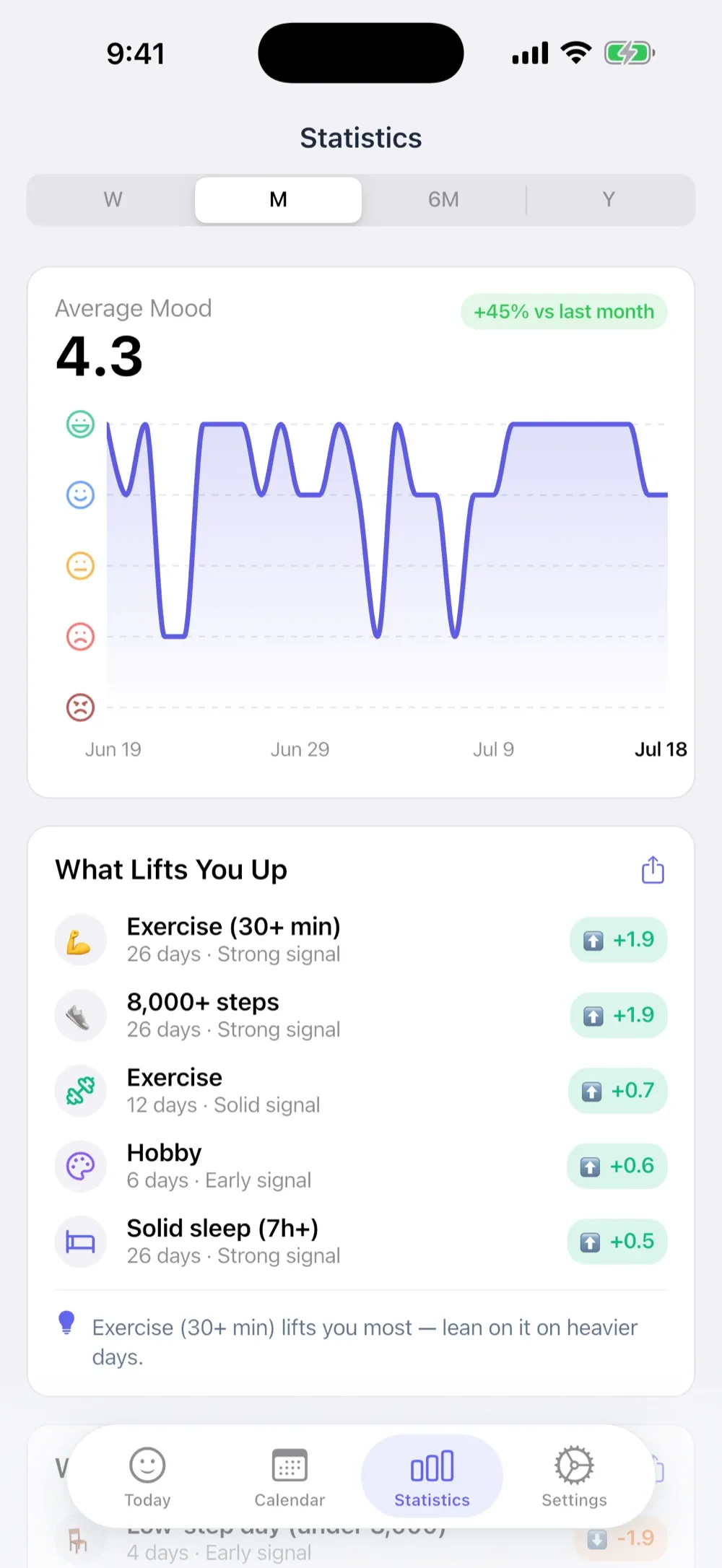
At 30 entries, the monthly comparison puts December next to November so you can see whether the season moved your average at all. For a surprising number of people it doesn’t, and knowing that removes a layer of dread for next year.
Protect the lifts, not just the limits
Holiday advice is almost all subtractive: say no, spend less, leave early. The data usually argues for the other column too. Whatever tops your good list is worth scheduling, on purpose, into the worst week. MoodKit’s try-a-habit experiment runs that as a seven-day test with a verdict from your own entries: a daily daylight walk from December 15, say, or a micro-act of joy each morning, or a short gratitude entry before bed. If the verdict says it helped, it goes into next year’s plan; if not, you’ve saved yourself a resolution.
The same tool answers the family question, the one 30% of adults handle by limiting time. “Family” as a tag, across a few visits, is either on your good days or your bad ones. Neither answer is wrong; both are better than guessing. If a specific relative or a specific setting is the drag, that’s worth knowing precisely, and it’s the kind of thing memory smooths over by January.
The grief exception
Missing someone was the top holiday worry in the 2025 poll, and it’s the one a tracker should handle gently. Grief doesn’t need ranking. If a “quiet evening remembering” tag ranks low, that’s not a reason to cut it. Track around it, not through it: keep the check-ins, notice which days were bearable and what was in them, and let the ranking work on the logistics rather than the loss. If the low stretches for weeks, or the season brings the kind of dark that doesn’t pass, that belongs with a professional; the autumn mood guide has the referral starting points.
MoodKit’s limits: it doesn’t track spending, it doesn’t know the calendar (the tags are yours to add), there’s no Apple Watch app, and the deeper insight cards are Premium after the free trial ($39.99 a year or $79.99 once; logging itself is free). What it does is turn “the holidays are stressful” into a short, specific list, which is the only version you can do anything about.
Frequently asked questions
How common is holiday stress?
Very. The American Psychological Association has found nearly nine in ten US adults say something stresses them between Thanksgiving and New Year's, and in the American Psychiatric Association's November 2025 poll, 41% expected more holiday stress than the year before, up from 28% in 2024.
What are the biggest holiday stressors?
In the 2025 American Psychiatric Association poll: missing someone or grief (48%), affording gifts (46%), difficult family dynamics (32%), and loneliness (31%). A separate YouGov survey put reduced daylight level with family dynamics, at 36% each.
How do I know which part of the holidays stresses me?
Tag the parts separately in a mood tracker: family time, travel, shopping, hosting, parties, alcohol, time alone, daylight. After two weeks the ranking shows which tags sit on your worst days and which on your best, which is rarely what you'd have guessed.
Do the holidays help mental health for some people?
Yes. In the same 2025 poll, 44% said the holidays have a positive effect on their mental health, against 21% negative. Most people have both kinds of days in December; tracking tells you what makes the difference.
Keep reading

Sunday Scaries: Track Them for Two Weeks and Watch Them Shrink
Most workers dread Sunday night. Two weeks of fifteen-second check-ins show whether your scaries are about Monday, about sleep, or about the weekend itself.
· 5 min read
Micro-Acts of Joy: Run the 7-Day Big Joy Protocol on Your Data
17,598 people did one small joyful act a day for a week and reported better mood, less stress, and better sleep. Here's how to run the seven days and measure yours.
· 4 min read

Does Gratitude Journaling Work? Test It on Your Own Mood in 14 Days
A 2025 meta-analysis of 24,804 people found gratitude practice lifts well-being by a small, real amount. Here's how to find out whether it does anything for you.
· 5 min read