Does Gratitude Journaling Work? Test It on Your Own Mood in 14 Days

The MoodKit Team
· 5 min read

Gratitude journaling has the best publicity of any habit in the self-help aisle and some of the most carefully hedged science. Both are true at once, which is why “does it work?” gets such confident answers in both directions.
Here’s the state of the evidence as of 2026. A meta-analysis published in PNAS in July 2025, pooling 145 papers and 24,804 participants across 28 countries, found gratitude interventions raise well-being by a small amount: a Hedges’ g of 0.19 overall, from 0.12 for reducing negative feelings to 0.28 for composite well-being, with real differences between countries. On the clinical side, Cregg and Cheavens’ 2021 meta-analysis of 27 studies found small reductions in depression and anxiety symptoms (g around −0.29 at post-test, −0.23 at follow-up) that shrank to nearly nothing against psychologically active comparison activities, and the authors advised people with real symptoms to reach for treatments with stronger evidence.
So: small, real, on average. And “on average” is doing a lot of work in that sentence. Some people in those trials moved a lot; some moved nowhere. The only way to know which you are is to run the trial on yourself, which takes two weeks and a tracker. (Disclosure: we build MoodKit, the tracker in the examples. Not medical advice; gratitude practice is a well-being habit, not a treatment for depression.)
Why the average result doesn’t settle it for you
Two features of the research make individual testing worthwhile. First, the response is uneven, and the studies that dig into who benefits find the practice helps people who start lower on well-being more than people already doing fine. Second, timing matters: a six-week randomized trial found the improvement in mental well-being ran through increases in grateful mood, and those showed up at four weeks, not at two. Whatever you feel in the first few days is mostly novelty, in either direction.
That’s the design brief for a fair self-test: at least two weeks, a mood measure that isn’t the journal itself, and a way to compare against your own baseline instead of against a pamphlet.
The 14-day protocol
Set up. Add “gratitude” as a custom activity in MoodKit. Keep the journal wherever you like (paper is fine); the tracker’s job is only to record that you did it and how you felt. A fifteen-second check-in in the morning and one at night is enough.
Practice. Each evening, three specific things from that day, with the reason they mattered. The journal prompts list has variants if the well runs dry by day nine, which it will. Then tag the night’s check-in with “gratitude.” On nights you skip, don’t tag it; the skips are the control group.
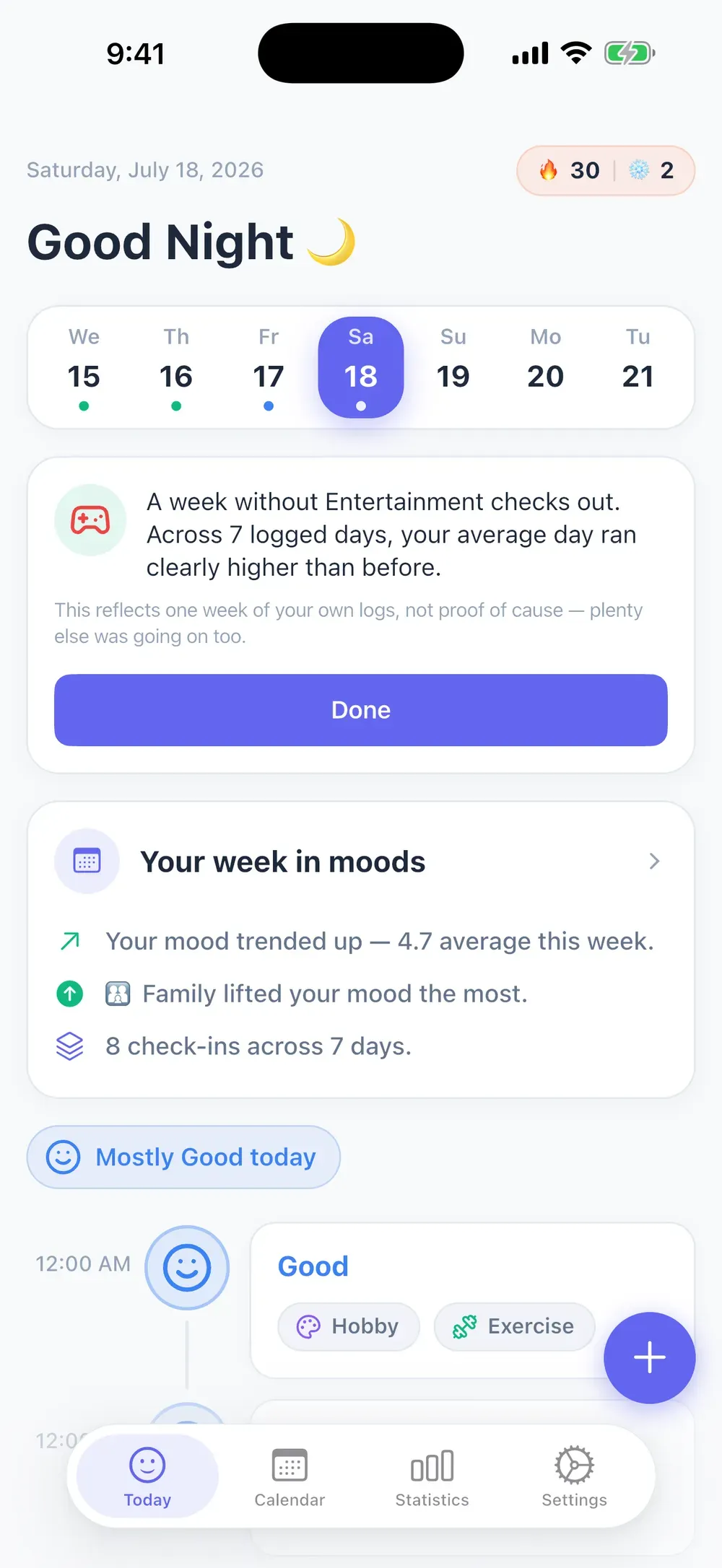
Measure. After 14 days, MoodKit’s Impact Leaderboard ranks “gratitude” against everything else you tagged by its measured effect on your mood, with day counts. Better, run it as a formal try-a-habit experiment: the app compares the week against your baseline and gives a verdict from your own entries.
| Variant | Time per day | What the evidence says | How to tag it |
|---|---|---|---|
| Three good things, nightly | 3 min | The standard format in most trials | ”gratitude” on the evening check-in |
| Gratitude letter, weekly | 15 min | Larger one-off lifts in several studies | ”gratitude letter,” compare the next day |
| Grateful text to someone | 1 min | Overlaps with social micro-acts | ”thanked someone” |
| Morning version | 3 min | Less studied; worth testing for morning people | ”gratitude am” |
Facts checked September 2026.
Reading your verdict
Three plausible results. A clear lift: gratitude nights sit above your baseline, and the leaderboard puts the tag near the top. Keep it, and consider the four-week extension the research suggests. A flat result: nothing moved. That’s common, and it’s information, not failure; try the letter variant or a micro-act of joy instead, which tests the doing side of the same idea. A dip: rare, but real for some people, usually because the practice turned into forced positivity on days that weren’t good. Stop, and see the next section.
One aside, since it’s the most common mistake we see: if the practice stops working around day ten, it’s usually the list, not you. “Coffee, my dog, my partner” three nights running is not gratitude, it’s inventory. Specific and different each night is what the trials actually tested.
When gratitude practice backfires
The practice is not a way to argue yourself out of a bad day, and using it that way is how people come to hate it. If the evening entry becomes “I should be grateful, so why do I feel like this,” you’re doing suppression with extra steps. Better: write the three things and log the honest mood. A tracker makes that easy, because the mood score and the gratitude tag are separate fields, and the point of the exercise is to see whether the tag moves the score over weeks, not to make tonight’s score look better.
MoodKit’s limits: it isn’t a journal (notes are short and optional, so the three things live on paper or in your notes app), there’s no Apple Watch app, and the deeper insight cards are Premium after the free trial ($39.99 a year or $79.99 once; logging itself is free). What it adds is the one thing gratitude journals can’t do for themselves: tell you, after two weeks, whether yours is working.
Frequently asked questions
Does gratitude journaling actually work?
On average, a little. A 2025 meta-analysis in PNAS covering 24,804 people across 28 countries found a small positive effect on well-being (Hedges' g of 0.19). The effect on depression and anxiety symptoms is also small, and shrinks against active comparison activities.
How long does it take for gratitude journaling to work?
A six-week trial found the mental-well-being benefit showed up through rises in grateful mood at four weeks, not two. So run at least two weeks before judging, and be ready to extend to four if the early result is promising but unclear.
What should I write in a gratitude journal?
Three specific things from the day, with the why: "the neighbor who moved my bin, because I'd forgotten," not "my family." Specific and varied beats long and repetitive; rote lists are the fastest way to make the practice stop working.
Is a gratitude journal the same as a mood tracker?
No. A gratitude journal is the practice; a mood tracker is the measurement. Tag the practice as an activity in the tracker and after a couple of weeks it can tell you whether the practice is moving your mood, which the journal alone can't.
Keep reading

30 Mood Journal Prompts That Take Two Minutes or Less
Short, specific prompts for morning, evening, bad days, and weekly reviews, built for check-ins you'll still be doing in December, not day-one essays.
· 4 min read

Micro-Acts of Joy: Run the 7-Day Big Joy Protocol on Your Data
17,598 people did one small joyful act a day for a week and reported better mood, less stress, and better sleep. Here's how to run the seven days and measure yours.
· 4 min read
Self-Experiments: Test What Actually Lifts Your Mood
The n-of-1 method for mood: how to test one habit for one week and get an answer you can trust — including the traps that fool most self-experimenters.
· 4 min read