Best Mood Tracker Apps for iPhone & iPad in 2026 (7 Picks)
The MoodKit Team
· 4 min read
Any mood app can run on an iPhone. A much shorter list actually behaves like it lives there: widgets that log with one tap, Lock Screen check-ins, Apple Health flowing both directions, State of Mind entries that outlive the app itself. That integration is what this ranking measures, because on a phone you unlock 100 times a day, friction decides whether your mood log survives.
(Disclosure: we build MoodKit, #1 below, and this is a category where our iOS-only focus genuinely pays off. Facts checked August 2026; US pricing.)
The iOS integration scoreboard
| App | Widgets | One-tap log | Lock Screen | Reads Health | Writes State of Mind | Min iOS |
|---|---|---|---|---|---|---|
| MoodKit | 4 types incl. Year in Pixels | Yes | Yes | Sleep, exercise, steps | Yes (iOS 18) | 15 |
| Apple State of Mind | Smart Stack | Yes | Yes | It is Health | Native | 17 |
| Moodistory | 5 widgets | Shortcuts | Yes | Limited | No | varies |
| Daylio | Basic | Opens app | No | Limited | No | 14 |
| How We Feel | Check-in | Opens app | No | Sleep, exercise, steps | No | 17 |
| stoic. | Yes + Watch/Mac | Opens app | — | Yes | No | 17 |
| Moodnotes | Basic + Watch | Opens app | No | No | No | 13 (stale) |
Facts checked August 2026. Details shift with updates; spot-check anything you’d rely on.
1. MoodKit — built for iOS, and it shows
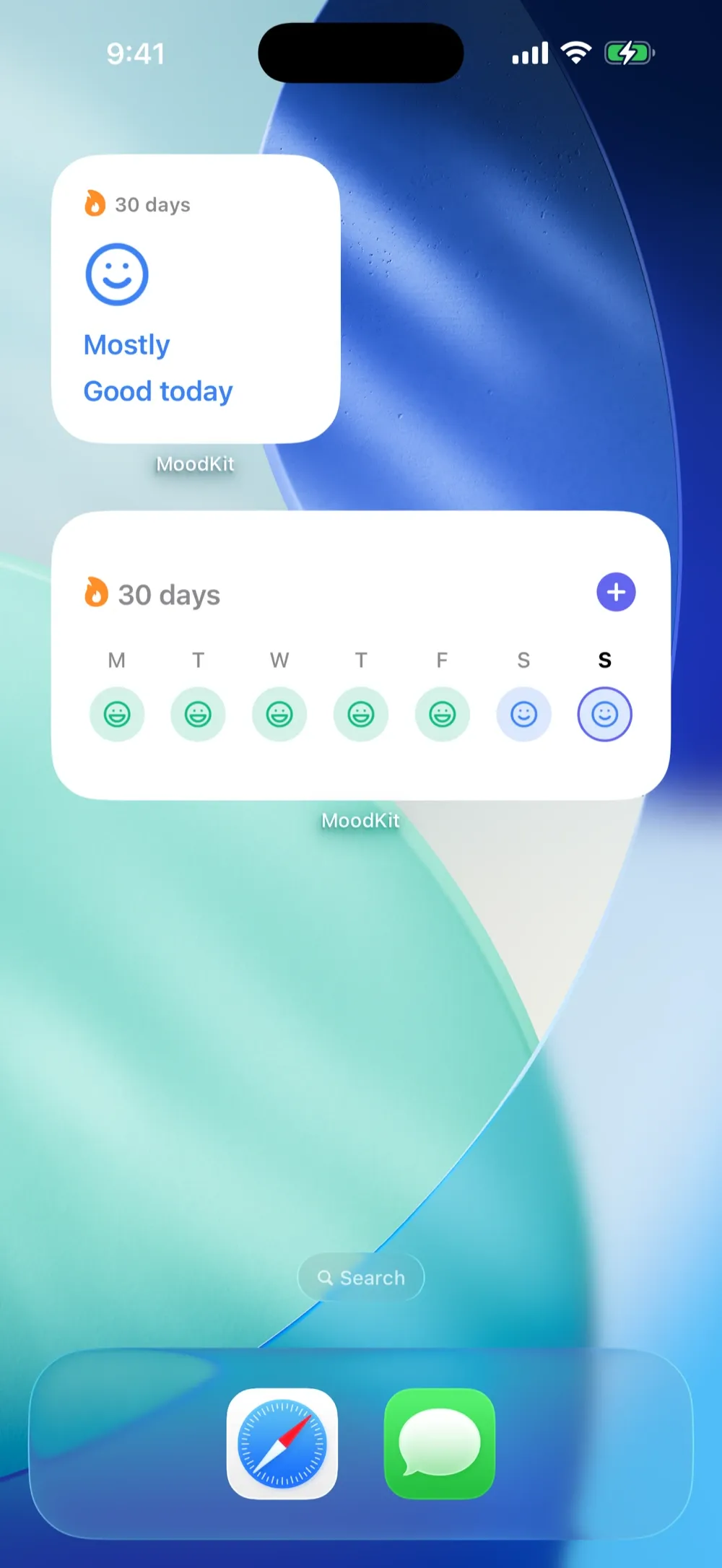
MoodKit treats the iPhone as the product, not a port target. Four widget types (today’s mood + streak, week view, a full Year in Pixels on your Home Screen, and Lock Screen circles) with true one-tap logging on iOS 17+. Reminder notifications carry five mood buttons, so a check-in survives days you never open the app. Apple Health flows both ways: sleep, exercise, and steps become ranked mood factors, and on iOS 18 every check-in writes back to Health as a State of Mind entry, keeping Apple’s archive complete while MoodKit does the analysis — ranked drivers with day counts, activity combos, and week-long self-experiments, all computed on-device with no AI and no account. It also reaches back to iOS 15, covering iPhones the iOS-17-only crowd abandoned.
- Best for: the deepest iPhone integration in the category.
- Watch out for: no Apple Watch app yet, no Android ever, and it’s paid after the trial ($39.99/year or a one-time $79.99 Lifetime).
2. Apple State of Mind — the baseline every app must beat
Free, preinstalled on iOS 17+, loggable from the Lock Screen and Apple Watch, end-to-end encrypted. As pure capture, it’s excellent. As understanding, it’s a timeline. Where it ends and dedicated apps begin is the subject of our full comparison.
- Best for: zero-install logging; the archive layer under any other app here.
3. Moodistory — widget enthusiast, privacy leaning
Moodistory ships five Home Screen widgets and markets itself hard on privacy. A solid diary-first pick if MoodKit’s analytics are more than you want.
- Watch out for: lighter insights; check its current Health support before assuming.
4. Daylio — great app, shallow roots in iOS
The category default earns its spot (full comparison), but its iOS integration is oddly thin for 2026: widgets open the app rather than log, there’s no Lock Screen presence, no State of Mind support, and the iOS app lock is paywalled.
- Best for: cross-platform insurance; its Android app means your data isn’t Apple-bound.
5. How We Feel — free, with real Health reads
The nonprofit gem reads sleep, exercise, and steps from Health to annotate your check-ins, which is more than most paid apps bother with. No State of Mind write, thin analysis, iOS 17+ only. (Alternatives when you want more.)
6. stoic. — the Apple-ecosystem journal
iPhone, iPad, Mac, Apple Watch, even iMessage. If you want guided journaling on every Apple screen you own, stoic. is the ecosystem play. Mood tracking is the side dish, not the meal.
7. Moodnotes — a Watch app frozen in 2024
Listed for one reason: it still has an Apple Watch app, which is rare here. But the whole product hasn’t updated since October 2024, so treat it as legacy.
Choosing on an iPhone specifically
- Put a widget where your thumb lands and prefer apps whose widget is the log (iOS 17 interactive widgets — the full widget guide ranks everyone).
- Demand Health citizenship. Reading sleep and activity gives a tracker context; writing State of Mind means your history survives switching apps. Both-ways apps respect you most.
- Check your iOS floor. On an iOS 15/16 phone, your realistic shortlist is MoodKit and Daylio.
And if you’re still weighing the whole market beyond Apple’s walls, the 10 best of 2026 is the wider map.
Frequently asked questions
Does the iPhone have a built-in mood tracker?
Yes. Since iOS 17, the Health app logs "State of Mind" entries from the app, the Lock Screen, or an Apple Watch. It's free and private, but it offers no custom activities and little analysis, which is why dedicated apps still exist.
What should an iPhone mood tracker integrate with?
Three things separate the natives from the ports: widgets (ideally with one-tap logging, an iOS 17 feature), Apple Health (reading sleep and activity, writing State of Mind), and Lock Screen presence. The table in this guide scores each app on exactly those.
Which mood tracker works on older iPhones?
MoodKit supports iOS 15+, and Daylio reaches even further back. How We Feel, stoic., and Apple's own State of Mind all require iOS 17, which rules out phones that stopped at iOS 16.
Do any mood trackers have an Apple Watch app?
Apple's built-in State of Mind logs from the Watch natively, and stoic. ships a Watch app. Moodnotes has one too, though the app hasn't been updated since 2024. MoodKit currently has no Watch app.
Keep reading
Best iPhone Mood Tracker Widgets in 2026 (Home & Lock Screen)
Which mood trackers actually ship useful iPhone widgets in 2026 — one-tap logging, streaks, and Year in Pixels grids — and which big names still have none.
· 4 min read
Mood Tracking with Apple Health: State of Mind, Sleep & Steps
How Apple's State of Mind logging works, what it can't tell you, and how apps like MoodKit turn Health data — sleep, exercise, steps — into ranked mood factors.
· 5 min read
The 10 Best Mood Tracker Apps in 2026, Compared Properly
Ten mood trackers, one honest table: prices, free tiers, insight depth, and who each app is actually for — including where our own app doesn't fit.
· 6 min read