Daylio vs MoodKit (2026): Which Mood Tracker Fits You?
The MoodKit Team
· 6 min read

Somewhere around check-in number two hundred, a lot of Daylio users hit the same wall. The streak is alive, the calendar looks like confetti, and yet they can’t answer one simple question: so what’s actually making my weeks good or bad?
That question is why MoodKit exists. And yes, we build MoodKit, so you should read this with one eyebrow raised. To keep us honest: every fact below is dated, sources are linked, and there’s a whole section on the things Daylio simply does better. There are several.
The short version? Daylio is the better diary. MoodKit is the better analyst. Daylio wins if you want a free, fast micro-journal with photos and Android support. MoodKit wins if you want answers: activities ranked by their measured effect on your mood, week-long self-experiments, and your sleep, exercise, and steps treated as evidence. All computed on your phone, no AI, no account.
Daylio vs MoodKit at a glance
| Daylio | MoodKit | |
|---|---|---|
| Platforms | iPhone, iPad, Android | iPhone, iPad (iOS 15+) |
| Free tier | Yes, generous | Free download + full-feature trial, then paid |
| Check-in | 2 taps, ~5 seconds | 1-tap moods, tag activities, optional note |
| Mood scale | 5 faces (customizable) | 5 moods + unlimited custom moods (any emoji, label, color) |
| Insights | Charts, counts, correlations | 4-tier insight engine: ranked drivers, best/worst weekdays, activity combos, catalysts and triggers |
| Self-experiments | Not available | Try a habit, skip a habit, or test next-day effects, with a verdict you can trust |
| Apple Health | Limited use | Reads sleep, exercise, steps as mood factors; writes State of Mind (iOS 18) |
| Widgets | Home Screen widgets | Home + Lock Screen widgets, one-tap logging, full Year in Pixels widget |
| App lock | Paywalled on iOS | Face ID / Touch ID lock included |
| Photos in entries | Yes | No |
| Languages | ~34 | 11 |
| Premium price (US) | $4.99/mo · $35.99/yr · $59.99 lifetime | $39.99/yr (1-week free trial) · $79.99 lifetime |
Facts checked August 2026. US App Store pricing; both apps change prices whenever they feel like it.
What’s actually the same
Both apps make the same core bet: a mood log you’ll still be filling in come December. Pick a mood, tag what you were doing, done. Both have streaks, calendars, and a Year in Pixels view. If you’ve used one, the other feels familiar within a minute.
Where Daylio is simply better
Let’s get our own app’s losses on the table first.
- A real free tier. You can track moods and activities in free Daylio forever. MoodKit gives you a trial with everything unlocked, then asks for money.
- Android. MoodKit is iPhone and iPad only. If there’s any chance you’ll switch platforms, Daylio travels with you.
- Photos. Daylio entries can hold pictures, which quietly turns it into a visual diary. MoodKit can’t do this.
- Customization depth. Daylio advertises thousands of activity icons plus unlimited custom moods and groups. MoodKit supports custom moods and activities too, but Daylio’s catalog is in another league.
- Track record. A 4.8-star average from roughly 61,000 US ratings (App Store, August 2026) and a decade of updates. MoodKit is young and still earning that trust.
- A cheaper lifetime. $59.99 vs MoodKit’s $79.99. Twenty dollars is twenty dollars.
What MoodKit does that Daylio doesn’t
Here’s the funny thing: the best pitch for MoodKit was written by a Daylio user. Daylio’s most-featured App Store review, titled “Wonderful yet lacking,” praises the app and then asks: “Am I learning anything from recording all of this?” The same reviewer wishes they could run experiments on their habits, and notes that Daylio’s correlations sometimes blame harmless activities just because they showed up on bad days.
MoodKit is basically that review, turned into an app.
- Ranked drivers, not wallpaper charts. The Impact Leaderboard sorts your activities by measured effect on your mood and shows the day counts behind every claim. You see what lifts you up and what drags you down, in plain words.
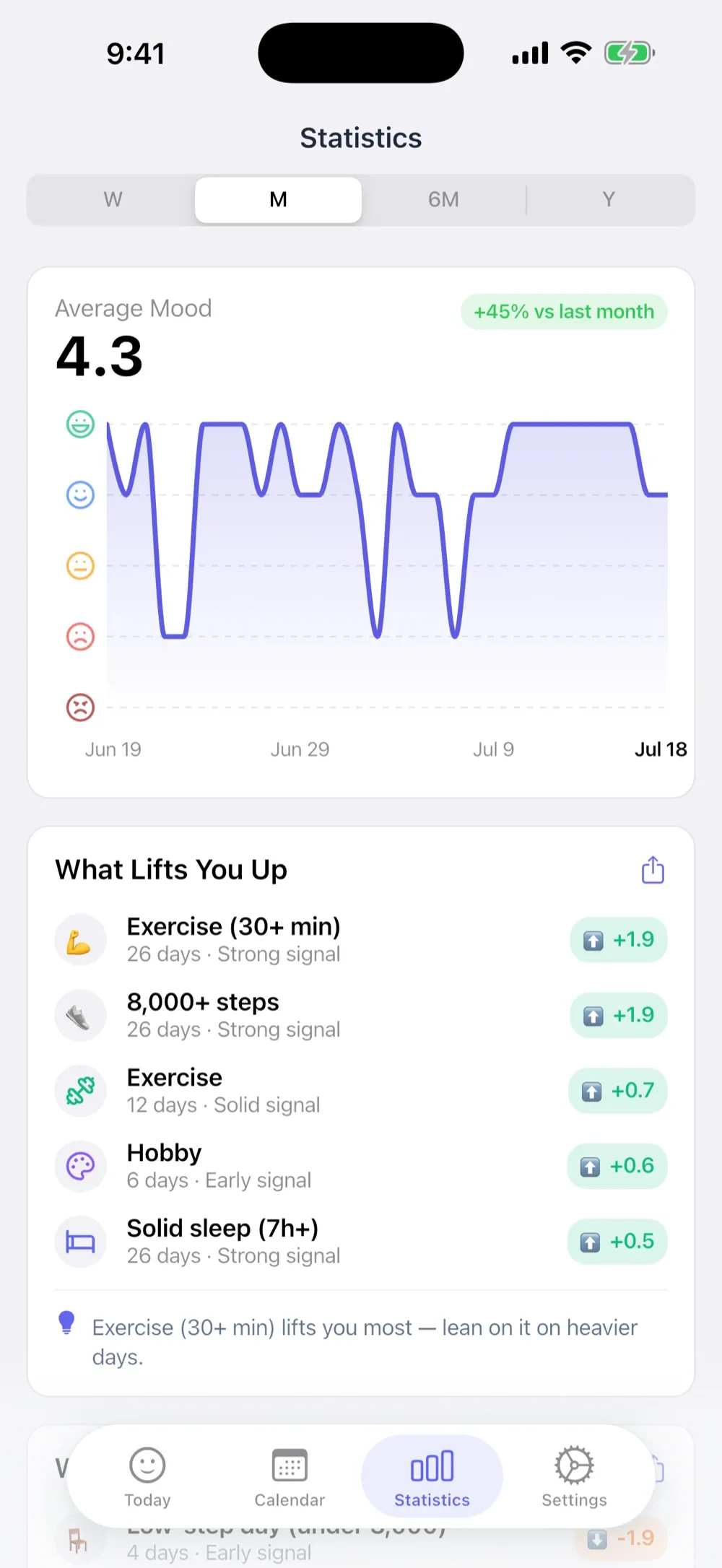
- Self-experiments. The feature that reviewer begged for. Try a habit for a week. Skip a suspect one. Or test next-day effects, like whether a late night hurts tomorrow’s mood. MoodKit re-measures against your own baseline and will happily conclude “this didn’t help.” A tracker that can’t disappoint you can’t inform you either.
- Activity combinations. Hidden Patterns catches pairings you’d never spot yourself, like what happens on days that mix late caffeine with poor sleep. Single-activity stats miss these.
- Apple Health as evidence. With permission, last night’s sleep, your exercise minutes, and steps get ranked right alongside your tagged activities. Daylio barely touches this. MoodKit also writes your check-ins to Apple Health as State of Mind entries on iOS 18. More in our Apple Health guide.
- Widgets that actually log. Home and Lock Screen widgets with true one-tap logging, plus a full Year in Pixels widget: your whole year, on your Home Screen.
- No AI anywhere. Every insight is plain statistics computed on your device. Nothing you feel gets sent to a chatbot, and you can always see why MoodKit says what it says.
- App lock included. Daylio paywalls its PIN and Face ID lock on iOS. We think a privacy feature is a strange thing to charge extra for, so MoodKit’s Face ID / Touch ID lock is just… included.
Privacy
Both apps store your entries locally by default, and neither shows ads. The differences: Daylio offers optional backups to your own cloud drive, while MoodKit has no account of any kind, works fully offline, and syncs only through your own private iCloud if you turn sync on. Like most apps, MoodKit uses standard analytics and crash reporting to keep itself working. That data is about the app, never about how you feel.
The call
Daylio if: you want free, you’re on Android (or might be), you like photo memories, or customizing icons is half the fun for you.
MoodKit if: you’ve tracked for months and learned nothing, you want experiments and ranked drivers instead of raw charts, and you live in the Apple ecosystem.
Trying both costs nothing. Daylio’s free tier is permanent, and MoodKit’s trial opens every feature before you pay a cent. If Daylio’s simplicity wins, keep it. If you eventually want more answers from all that data, you know where the gap is.
Frequently asked questions
Is MoodKit just a Daylio copy?
No. The check-in flow looks similar (pick a mood, tag activities), but the focus is different. Daylio is built around fast journaling and streaks. MoodKit is built around explaining your mood: it ranks which activities lift you up or drag you down, finds activity combinations, and lets you run week-long self-experiments on your own habits.
Can I import my Daylio data into MoodKit?
No, MoodKit has no Daylio importer today. You'd start fresh. MoodKit shows its first feedback after 3 check-ins, early patterns at 7, and its full insight engine at 30, so a few weeks of normal logging rebuilds a useful picture.
Does Daylio have a free version?
Yes, and it's genuinely usable: free Daylio includes mood logging, activities, and basic stats, with Premium adding deeper charts and perks. MoodKit works differently. It's free to download with a free trial of every Premium feature, and after the trial you subscribe or buy the one-time Lifetime unlock.
Which app is better for privacy?
Both keep your entries on your device by default. MoodKit goes a step further on two points: there is no account at all, and the Face ID app lock is included rather than paywalled. MoodKit computes every insight on your device with no AI, and its optional sync goes only to your own private iCloud.
Keep reading

7 Best Daylio Alternatives in 2026 (Matched to Why You're Leaving)
The best Daylio alternatives, matched to the reason you're switching: deeper insights, symptom tracking, a one-time price, clinical charts, or pure simplicity.
· 5 min read

Daylio vs Bearable (2026): Full Comparison, Plus a Third Option
Daylio is the fastest mood diary; Bearable is the deepest health tracker. Here is how they actually differ in 2026 — and when neither is the right fit.
· 4 min read

Best iPhone Mood Tracker Widgets in 2026 (Home & Lock Screen)
Which mood trackers actually ship useful iPhone widgets in 2026 — one-tap logging, streaks, and Year in Pixels grids — and which big names still have none.
· 4 min read