Falling Back on November 1: What the Clock Change Does to Mood
The MoodKit Team
· 4 min read

On Sunday, November 1, at 2 a.m., US clocks go back an hour, and the internet will tell you to enjoy the extra sleep. That’s the sleep story, and it’s mostly true. The mood story is different, and less often told.
In 2017, researchers in Denmark looked at 185,419 hospital contacts for unipolar depression between 1995 and 2012 and found an 11% rise in new depressive episodes after the autumn switch from summer time to standard time, fading over roughly ten weeks. The spring change showed no parallel rise. Their reading, which is also the intuitive one: the problem isn’t the hour of sleep, it’s that the sun now sets an hour earlier by the clock, and the evening light you were leaning on vanishes in a single night.
Most people won’t get anywhere near a diagnosis. But a smaller version of the same dip, a week or three of lower evenings, is common enough that it’s worth measuring on yourself rather than guessing. (Disclosure: we build MoodKit, the tracker in the examples. This is a tracking guide, not medical advice; if a seasonal dip gets deep or won’t lift, that belongs with a professional, and in the US the 988 Lifeline is there any hour.)
The extra hour is not the story
The Sleep Foundation’s summary is that major sleep disruption is less likely in November than in March, which fits: gaining an hour is easier on the body than losing one. The American Academy of Sleep Medicine goes further and recommends permanent standard time as the healthier year-round option, precisely because morning light matters more than evening light for the body clock.
Politics is heading the other way. The Sunshine Protection Act, which would make daylight saving time permanent, passed the House in July 2026 and is waiting on the Senate, so this November may or may not be one of the last fall-backs. Either way, the variable that moves mood this week is the same: how much light you see, and when.
Two weeks of data, one clock change
The clock change is a natural experiment with a hard edge, which is rare in mood tracking. You know the exact day. So the plan is simple: log the week before, log the two weeks after, and compare.
| Window | What to log | What to look at |
|---|---|---|
| Oct 25 to 31 | Two check-ins a day, tag “daylight walk” when it happens | Your baseline evening mood |
| Nov 1 to 7 | Same, plus a “late night” tag if you drift later | Whether evenings drop, and by how much |
| Nov 8 to 14 | Same, deliberately get morning light 4+ days | Whether the light days rank above the others |
Facts checked September 2026.
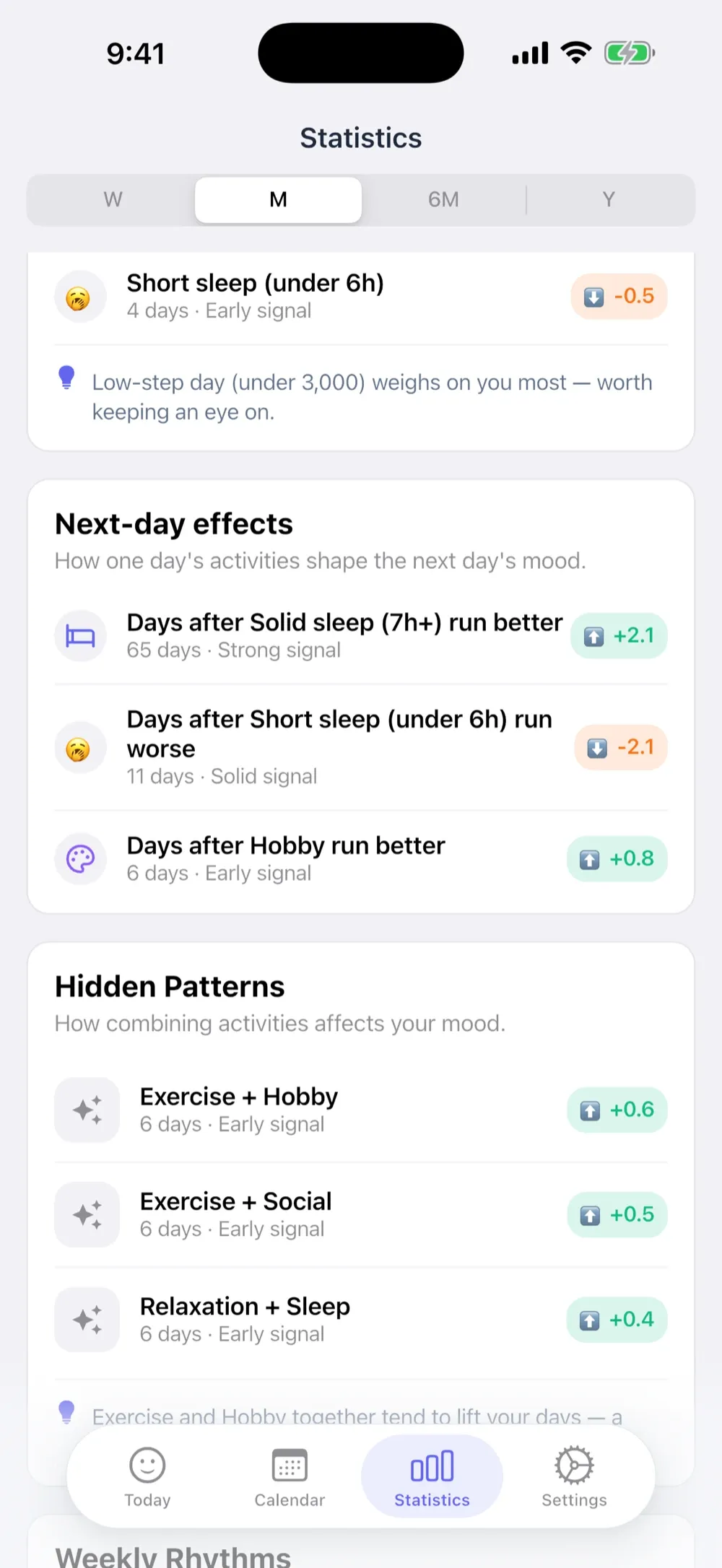
A fifteen-second check-in morning and evening is enough. Tag the things that could plausibly matter: the daylight walk, exercise, a late night, alcohol, the first dark 5 p.m. commute. If you use Apple Health, MoodKit reads last night’s sleep, exercise, and steps automatically and ranks them next to your tags, so the sleep half of the story takes care of itself; the sleep and mood guide has the detail.
Reading the result
Three outcomes, roughly. If your evening mood holds steady across the change, good; you’re one of the people the clock doesn’t move much, and you can stop worrying about it. If it dips in week one and recovers by week two, that’s the adjustment curve, and the tags will show which days pulled it back up. If it dips and keeps dipping into mid-November, you’re looking at the seasonal slide rather than the clock, and the autumn baseline guide is the next read.
The tag that matters most is morning light. In our experience it ranks near the top of the Impact Leaderboard for people who bother to get it, and near the bottom of the list of things people bother to do. A twenty-minute walk before work, four days out of seven, is the cheapest test in this article. MoodKit’s Weekly Rhythms view also catches the pattern the clock change tends to create: fine weekends, flat weekday evenings, because the weekday commute is now in the dark.
Making the adjustment stick
Three moves that the data usually backs, and one way to check each: keep wake time fixed rather than banking the extra hour (a “slept in” tag will tell you whether sleeping in helps or hurts your day); move exercise earlier, into daylight, and let the leaderboard compare the two versions; and run a one-week next-day experiment on “late night,” since the dark evenings make drifting later easier and the cost tends to land the next morning.
MoodKit’s limits: it doesn’t know the sunset time or the weather, so light exposure is a tag you add yourself; there’s no Apple Watch app; and the deeper insight cards are Premium after the free trial ($39.99 a year or $79.99 once; logging itself is free). What it does is the part memory can’t: tell you, in your own numbers, whether this year’s fall-back cost you anything, and which of the standard advice actually paid off.
Frequently asked questions
When does daylight saving time end in 2026?
Sunday, November 1, 2026, at 2:00 a.m. local time in the US, when clocks go back one hour. The UK and EU switch a week earlier, on October 25.
Does falling back affect mood?
For many people, yes. A Danish registry study of 185,419 depression diagnoses found an 11% rise in new unipolar depressive episodes after the autumn switch to standard time, fading over about ten weeks, with no matching rise after the spring change.
Why does the fall time change feel worse than spring?
Sleep-wise it's easier: you gain an hour. Mood-wise, the sun now sets an hour earlier by the clock, so the evening light most people relied on disappears in one step, on top of days that were already shortening.
How do I adjust to the end of daylight saving time?
Get outside in the morning light for a few days after the change, keep wake time steady rather than sleeping in, move exercise earlier, and protect the evening from screens. Then check your own mood record to see which of those actually helped.
Keep reading
Sleep and Mood: Stop Guessing, See It in Your Own Data
Fifty years of research says sleep loss drags mood down. Here's how to measure the effect in your own life with Apple Health and a two-week log.
· 3 min read

Autumn Mood Dips: Build Your Seasonal Baseline Now
Days are shortening and September moods are already sliding. How to track a seasonal pattern properly, when the data means something, and when to get help.
· 3 min read
Sunday Scaries: Track Them for Two Weeks and Watch Them Shrink
Most workers dread Sunday night. Two weeks of fifteen-second check-ins show whether your scaries are about Monday, about sleep, or about the weekend itself.
· 5 min read