Caffeine and Mood: Test Your Coffee Cutoff Before You Quit It
The MoodKit Team
· 5 min read
The “I quit caffeine for 30 days” video is a genre now, and the arc is always the same: three days of misery, a week of fog, then a slow reveal of calm the creator never knew they were missing. It’s persuasive. It’s also one person, with no baseline, describing the worst-designed experiment in wellness.
The research says two things at once. Caffeine lifts mood, in the morning, reliably. And caffeine wrecks sleep later than you think, which costs mood the next day. Both effects are real, they pull in opposite directions, and the balance between them is yours, not the creator’s. The fix isn’t quitting on faith. It’s finding your cutoff with a two-week test, and only then deciding whether quitting is worth nine days of headache. (Disclosure: we build MoodKit, the tracker in the examples. Not medical advice; if you’re pregnant, have a heart or anxiety condition, or take medication caffeine interacts with, talk to a clinician about intake instead of experimenting.)
The morning lift is real
A study in Scientific Reports from August 2025 followed 236 young adults across two studies of 14 and 28 days, with mood surveys several times a day, more than 28,000 of them. Caffeine was followed by a rise in positive affect, and the association was strongest within about two and a half hours of waking. Effects on negative affect were inconsistent. Tiredness and social context changed the size of the lift, which fits everyday experience: the first coffee after a bad night does more than the third on a good one.
So the morning cup earns its place. If a tracker shows “coffee am” ranking high on your Impact Leaderboard, that’s the science reproducing on you, not a placebo.
The evening tax is larger than it feels
The classic sleep study here is Drake and colleagues, 2013: 400 mg of caffeine (roughly two large coffees) taken at bedtime, three hours before, or six hours before. Even at six hours, objectively measured sleep dropped by more than an hour. The part that matters for this guide: the participants’ own reports didn’t register the loss. You can’t feel the tax, which is exactly why it needs a tracker rather than a hunch.
Lost sleep lands on the next day’s mood; the sleep and mood guide covers that mechanism and the evidence. Put the two studies together and you get a plausible daily pattern for a lot of people: a real lift from the morning cup, a hidden sleep cost from the 3 p.m. one, and a next-morning dip that gets blamed on Mondays.
Find your cutoff in two weeks
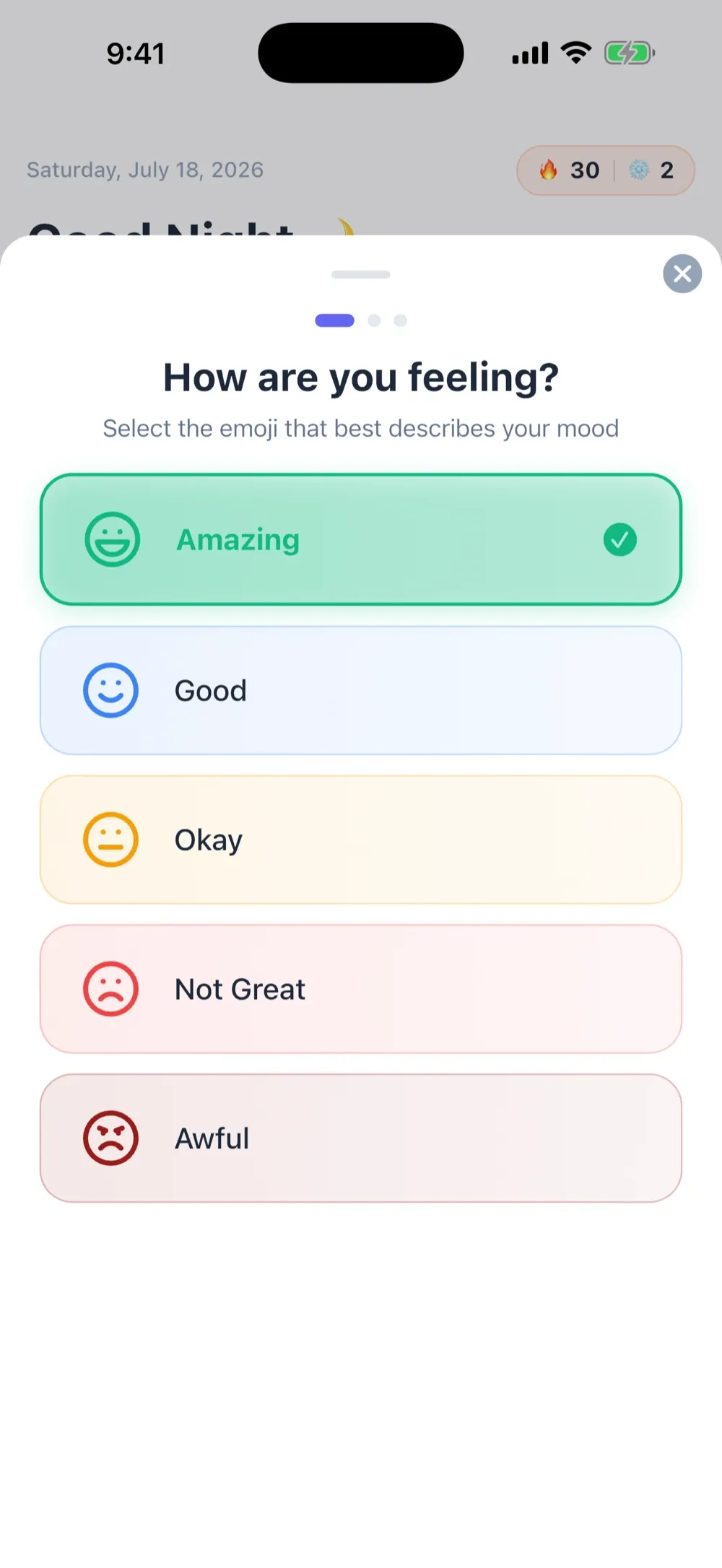
The trick is to tag caffeine by time of day, not just “coffee.” In MoodKit, that’s two custom activities, “coffee am” and “coffee pm” (anything after 2 p.m., say), added to a fifteen-second check-in. If you use Apple Health, last night’s sleep arrives automatically and ranks alongside the tags as a driver, so the sleep half of the mechanism shows up without any extra logging.
| Window | Tag | What to look at after two weeks |
|---|---|---|
| Within 2.5 hours of waking | ”coffee am” | Same-day mood; expect it near the top of the leaderboard |
| Early afternoon | ”coffee pm” | Next-morning mood and Health sleep on the nights after |
| Evening | ”coffee late” | Same, and usually the clearest negative |
| No caffeine day | (no tag) | The control; you need several of these |
Facts checked September 2026.
After about 14 entries, the Impact Leaderboard ranks the three tags with day counts. Then run the decisive test: MoodKit’s next-day experiment asks, in effect, “does afternoon coffee hurt tomorrow’s mood?” and answers from your own entries after a week. The self-experiments guide explains how the verdict is computed. Most people who run it don’t quit caffeine; they move the last cup earlier, keep the morning lift, and recover the sleep.
If you do decide to quit
Then know the timeline before you judge the result. Juliano and Griffiths’ review of caffeine withdrawal puts symptom onset at 12 to 24 hours after the last dose, peak intensity at 20 to 51 hours, and duration at two to nine days: headache, fatigue, low alertness, depressed mood, irritability, fog, sometimes flu-like symptoms. Dependence can form on as little as one cup a day.
That timeline is why a one-week skip experiment on caffeine is a bad design: the whole week is withdrawal. Either taper first (cut the afternoon cup, then halve the morning one), or run the skip for two weeks and treat the first nine days as noise. The 30-day video creators are, accidentally, doing the right thing; they just have no baseline to compare the calm against. You will, because you tagged the two weeks before.
One aside from our side: the calm people report after quitting is often the sleep coming back, not the absence of caffeine itself. If a tracker shows the same mood on an early-cutoff plan as on a full quit, you’ve found the cheaper version.
MoodKit’s limits: it doesn’t count milligrams or cups (a tag is a tag, and “coffee pm” means whatever you decide it means), there’s no Apple Watch app, and the deeper insight cards are Premium after the free trial ($39.99 a year or $79.99 once; logging itself is free). What it does is settle the argument the videos can’t: whether your coffee is lifting you, taxing you, or, most likely, both, at different hours.
Frequently asked questions
Does caffeine improve mood?
In the short term, yes, and mostly in the morning. Two studies tracking 236 young adults several times a day found caffeine was followed by a rise in positive mood, strongest within about 2.5 hours of waking, with little consistent effect on negative mood.
How late is too late for caffeine?
Later than most people think. A controlled study found 400 mg of caffeine taken six hours before bed cut measured sleep by more than an hour, and the participants didn't notice. Your own cutoff is testable: tag afternoon coffee for two weeks and compare the next mornings.
What happens to your mood when you quit caffeine?
Withdrawal starts 12 to 24 hours after the last dose, peaks at 20 to 51 hours, and lasts two to nine days: headache, fatigue, low mood, irritability, and fog. Judge any quit by the mood after that window, not during it.
Can caffeine cause anxiety?
High doses can raise anxiety in people prone to it, and it can worsen sleep, which feeds anxiety the next day. If you have an anxiety condition, a heart condition, or you're pregnant, talk to a clinician about your intake rather than running a self-test.
Keep reading
Sleep and Mood: Stop Guessing, See It in Your Own Data
Fifty years of research says sleep loss drags mood down. Here's how to measure the effect in your own life with Apple Health and a two-week log.
· 3 min read

The Dopamine Menu, Data-Tested: Keep What Actually Works
Dopamine menus are everywhere in 2026. Most are guesses. Here's how to build one, then let two weeks of mood data promote or fire every item on it.
· 4 min read
Self-Experiments: Test What Actually Lifts Your Mood
The n-of-1 method for mood: how to test one habit for one week and get an answer you can trust — including the traps that fool most self-experimenters.
· 4 min read