Functional Freeze: Signs You're Stuck, and a Way to Track Out of It

The MoodKit Team
· 5 min read

Nothing is wrong, exactly. You went to work, answered the messages, made dinner. You also haven’t opened the thing you were going to do for yourself in three weeks, the laundry has been folded on the chair for longer than that, and when a friend asks how you are, the true answer is “I can’t tell.”
TikTok calls this “functional freeze,” and the term has spread because it names something a lot of people recognize: the freeze branch of the stress response, run at a low simmer while life carries on. A Today.com explainer lists the four signs therapist Niro Feliciano, LCSW, sees in it: functioning outwardly but frozen on personal tasks; feeling “tired and wired”; starting things and not finishing; and, in heavier cases, drifting away from people. The same piece is careful to say it “is not an official psychological diagnosis.” Keep that in mind, because the label is useful right up to the point where it stops you getting a real assessment.
This guide is about the middle ground: how to tell whether you’re in it, and how a mood record helps you find the specific, small thing that unfreezes you. (Disclosure: we build MoodKit, the tracker in the examples. Not medical advice.)
What functional freeze looks like in a mood record
Numbness has a signature in data, and it’s not “low.” It’s flat. Two weeks of check-ins in a freeze state tend to sit at the same middle score, morning and evening, with very few tags, because you didn’t do anything worth tagging and didn’t feel anything worth rating. Compare that to a rough patch of ordinary bad mood, which swings: bad mornings, an okay evening, a good Saturday.
That distinction matters because the two need different responses. A swinging record has drivers in it, and the mood triggers guide is for that. A flat record has almost nothing in it yet, and the first job is to put some inputs in so there’s something to rank.
| Sign | How it shows in a tracker | First move |
|---|---|---|
| Frozen on personal tasks | Work tags present, everything else absent | Add three tiny “for me” tags and try them |
| Tired and wired | Middling mood, poor Health sleep, low steps | Log sleep and steps automatically and read them as drivers |
| Can’t finish things | ”Started X” tags with no “finished” | A ten-minute-task tag, then compare days with and without |
| Pulling away from people | No social tags for a week or more | One “texted someone” tag; see where it ranks |
Facts checked September 2026.
The smallest possible inputs
The standard advice for thawing a freeze is physical and small: get outside, move, breathe, laugh, work in short bursts, and stop shaming yourself for it. The Today.com piece lists exactly those. All of it is reasonable and none of it tells you which one is yours, which is why people in a freeze read five lists and do nothing; the lists are long and the energy isn’t there.
So make the list short and let data prune it. In MoodKit, add four or five custom activities that each cost under ten minutes: “walk,” “shower,” “ten-minute task,” “texted a friend,” “outside.” When you do one, tag it on a fifteen-second check-in. Don’t do all of them daily; that’s another to-do list. Do one when you can, and record it.
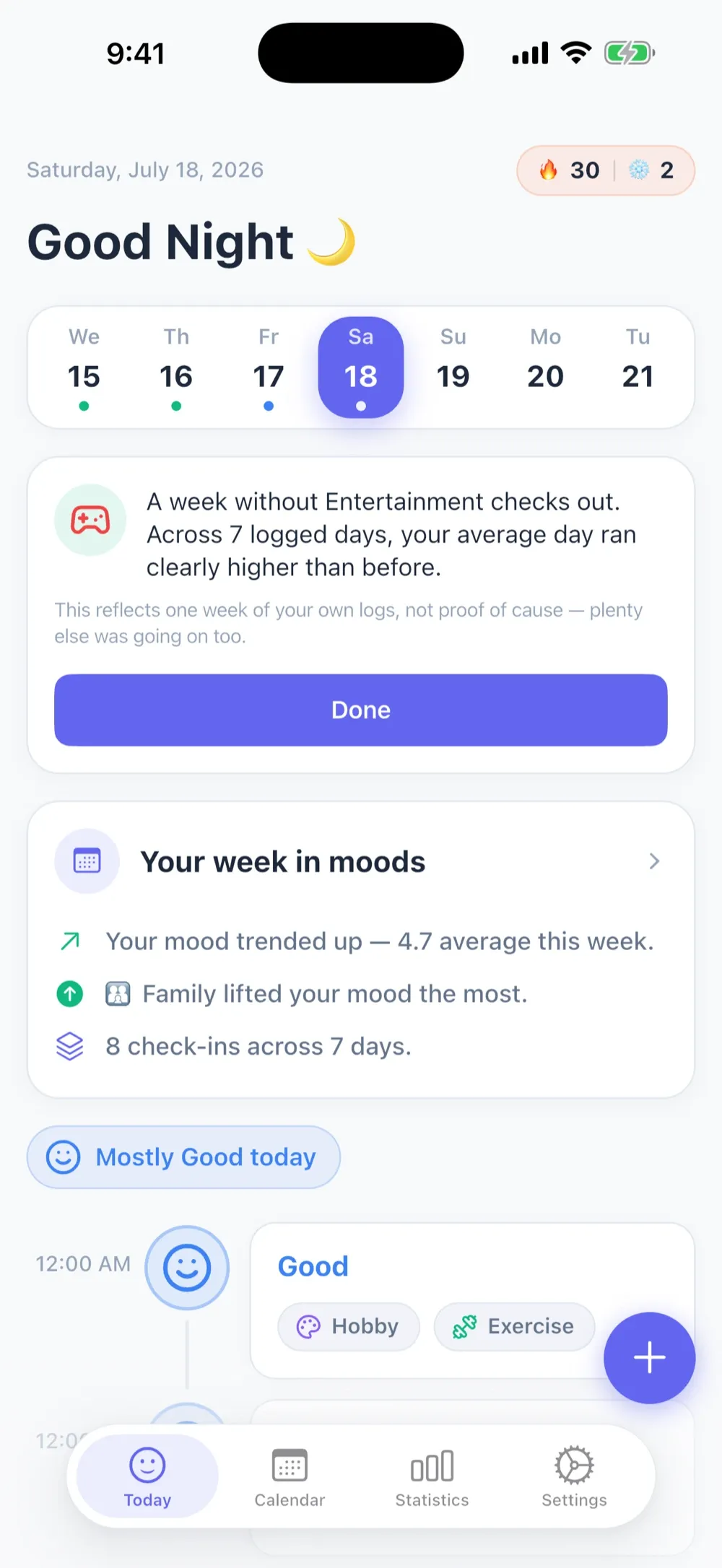
After about 14 entries, the Impact Leaderboard ranks those tags by their measured effect on your mood, with day counts. In a freeze, that ranking is usually lopsided in a helpful way: one input moves you and the rest don’t. That one becomes the lever. At 30 entries the app names your catalysts and triggers directly, which is the moment the “for me” list finally has a reason to exist.
Rule out the things that look like freeze
Three things wear the same coat. Burnout has the flatness plus a specific source (work) and tends to lift on days away from it; the burnout tracking guide shows how to test that. The seasonal dip starts in October and tracks daylight, which a tracker catches if you tag time outside. And depression overlaps with all of it. If the flatness has lasted more than two weeks, comes with changes in sleep or appetite, or you’ve stopped caring about things you used to love, please get it assessed by a clinician rather than filing it under a TikTok term. A tracker’s record, exported as CSV, is a useful thing to bring to that appointment.
Body-first practices help some people here, and the nervous-system regulation guide covers how to test them without buying the whole theory. The same rule applies: tag it, and let two weeks decide.
What thawing looks like in the numbers
Not a jump. A return of variance. The first sign that a freeze is lifting in a mood record is that the scores start moving again: a genuinely good Tuesday, a bad Thursday you can name the reason for. Tags multiply on their own because you start doing things. That’s the moment to switch from “add inputs” to the ordinary work of finding what lifts you and what drags you, which is what the app is built for the rest of the year.
MoodKit’s limits: it won’t send you a gentle nudge to go outside (reminders are for check-ins), there’s no Apple Watch app, and the deeper insight cards are Premium after the free trial ($39.99 a year or $79.99 once; logging itself is free). What it does is the part a frozen brain can’t: remember what you tried, and tell you which of it worked.
Frequently asked questions
What is functional freeze?
A popular name for a state where you keep doing what's required (work, chores, showing up) while feeling numb, flat, and unable to start anything for yourself. It's described as a low-grade version of the freeze branch of the stress response. It is not a clinical diagnosis.
What are the signs of functional freeze?
Functioning outwardly but frozen on personal tasks; feeling "tired and wired" at once; starting things and not finishing them; and, in heavier cases, pulling away from friends and family. Emotional flatness and a heavy, slowed-down body are common.
Is functional freeze the same as depression?
No, but they overlap, and only a clinician can tell them apart. If the flatness lasts more than two weeks, comes with changes in sleep or appetite, or you've lost interest in things you used to enjoy, get it assessed rather than self-labeling it.
How do you get out of functional freeze?
Small, physical, and specific: a short walk, a shower, one ten-minute task, a text to one person. Tag each in a mood tracker for two weeks and let the data show which one actually moves you; that's usually a shorter list than the advice suggests.
Keep reading

Nervous System Regulation: Prove Your Practice Works
Breathwork, cold plunges, somatic resets: wellness's biggest 2026 trend is easy to start and hard to evaluate. A mood log turns it into a fair test.
· 3 min read

How to Track Burnout Before It Tracks You: A 30-Day Method
Burnout creeps in over months, which is why a daily log catches it early. A 30-day method, the three signals to watch for, and when to stop tracking and get help.
· 5 min read

The Dopamine Menu, Data-Tested: Keep What Actually Works
Dopamine menus are everywhere in 2026. Most are guesses. Here's how to build one, then let two weeks of mood data promote or fire every item on it.
· 4 min read