Mood Swings: How to Track Them, and When the Pattern Needs a Doctor
The MoodKit Team
· 5 min read

A note before anything else: this is a tracking guide, not medical advice. Mood swings are usually ordinary, and sometimes they’re a symptom of something that needs a clinician, and the difference isn’t one a blog post or an app can make. What tracking can do is show you the pattern clearly enough to know which conversation to have, and give you a record to have it with. If you’re thinking about harming yourself, that’s an emergency, and in the US the 988 Lifeline is there any hour.
With that said. Cleveland Clinic’s definition is plain: mood swings are “sudden changes (swings) in how you feel at a particular time (mood)”, and everyone has them. Their list of causes is long: puberty, pregnancy and postpartum, menopause; thyroid problems, blood sugar, migraines, sleep deprivation, PMS and PMDD; depression, bipolar disorder, anxiety, ADHD, and others; alcohol, cannabis, and a range of medications. That list is the problem. “Mood swings” describes twenty different things, and the only way to find yours is to watch when they happen and what’s next to them. (Disclosure: we build MoodKit, the tracker in the examples.)
Why once-a-day tracking misses swings
Most people who track mood do it once, at night. That’s fine for “how was the month,” and useless for swings, because a swing is a within-day event: fine at 9, furious at 11, flat by 3, fine again by dinner. A single nightly “3 out of 5” averages the whole thing into nothing.
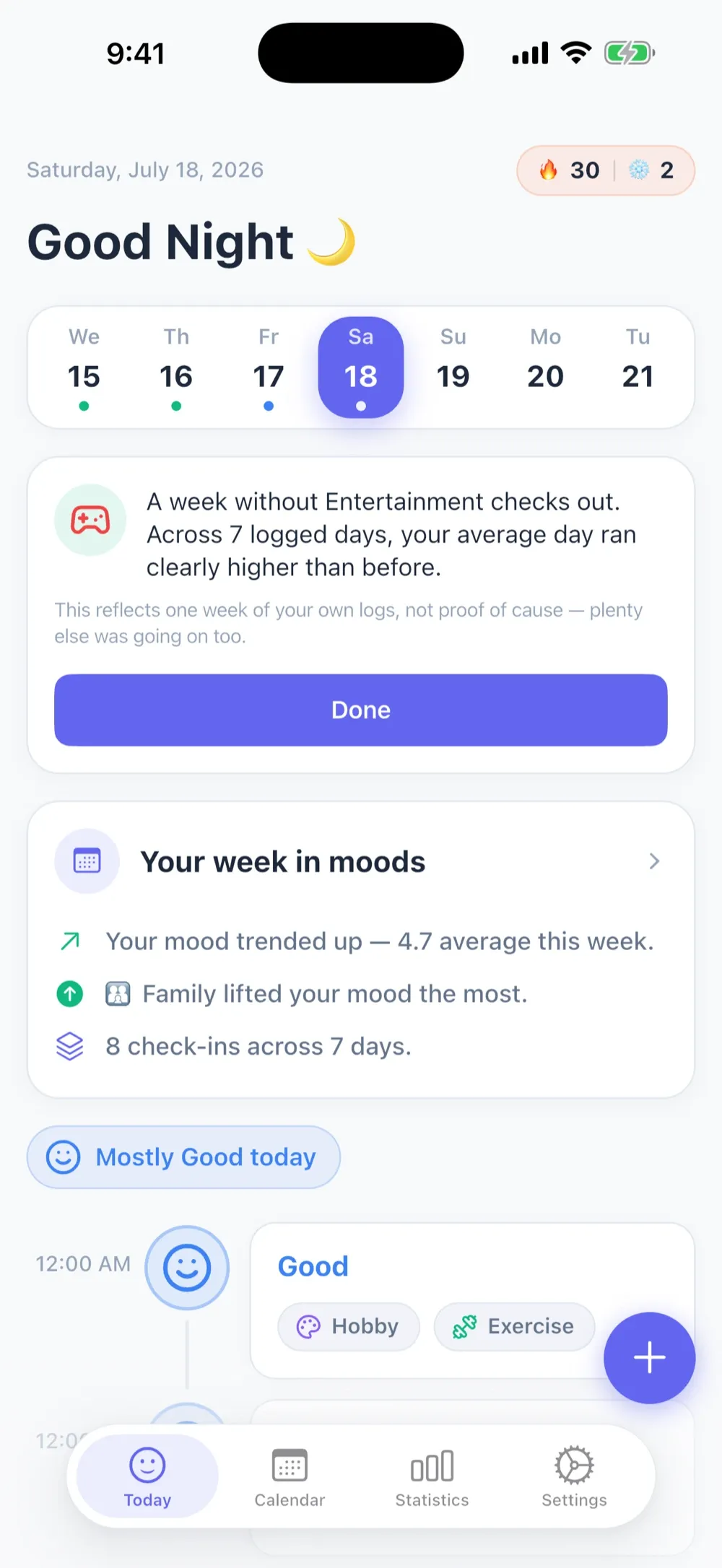
So the first change is frequency. Log when the mood changes, not on a schedule. In MoodKit that’s a fifteen-second check-in from the Lock Screen widget or a reminder, as many times a day as you need, and the daily timeline in the calendar shows the day as the sequence it actually was. The second change is the note: two words on what was happening right before. “Skipped lunch.” “Call with mom.” “Third coffee.” Over a few weeks those notes are the pattern.
Four patterns a record tends to show
| Pattern | What the record looks like | Where to go next |
|---|---|---|
| Sleep-driven | Swings cluster after short nights; Apple Health sleep ranks as a top driver | The sleep and mood guide |
| Cycle-driven | Swings recur on the same days each month, usually the week before a period | The cycle tracking guide; PMDD-scale swings go to a clinician |
| Substance-driven | Swings the morning after alcohol, or after the afternoon coffee | Next-day experiments; the caffeine guide |
| People and situation-driven | Swings follow a specific tag: a person, a meeting, a place | The mood triggers guide |
Facts checked September 2026.
After about 14 entries, MoodKit’s Impact Leaderboard ranks every tag and every Health factor by its measured effect on your mood, with day counts, and Hidden Patterns flags combinations you’d never test on purpose (short sleep plus a skipped meal is a classic). At 30 entries, the catalysts-and-triggers report names the strongest of each. For swings, the triggers side is the one to read first.
A fifth pattern exists, and it’s the one the table can’t hold: swings with no tag on them at all. Nothing preceded them. That’s not a failure of tracking; it’s a finding, and it’s one of the clearest signals that the next section applies.
When the pattern belongs with a doctor
Cleveland Clinic’s thresholds are worth quoting exactly. Talk to a healthcare provider when mood swings “happen more often,” “lead to stronger emotions,” “make you feel out of control,” “affect your work or schooling,” or “impact your relationships with others.” Mayo Clinic adds that if your emotions are getting in the way of work, relationships, or social life, or you’re leaning on alcohol or drugs, see a doctor or mental-health professional as soon as you can.
A tracker helps with two of those in particular. “More often” is a count, and a record has it. “Out of control” is easier to say to a doctor when you can show it: the timeline of a day, the number of swings a week, the weeks they’ve been going on. If the swings run in multi-day highs and lows rather than hours, that’s the pattern bipolar disorder can take, and it’s worth reading the bipolar tracking round-up for tools built for clinical charting; MoodKit isn’t one, and we say so there too.
What to bring to the appointment
Two to four weeks of entries, with times. MoodKit exports everything to CSV in one tap, and a clinician can read a spreadsheet of dated moods and notes far faster than they can reconstruct a month from memory. Bring sleep if you have it (Health data comes along in the app’s rankings), a list of medications and supplements, and the leaderboard’s top triggers, which is the shortest version of “here’s what seems to set it off.”
That’s also the honest boundary of what an app can do here. It can show the shape of the swings and what sits next to them. It can’t tell you whether that shape is a thyroid, a cycle, a sleep debt, or a mood disorder, and it shouldn’t try.
MoodKit’s limits: no symptom or medication tracking, no cycle tracking, no clinical episode charting or PHQ-style scales, no Apple Watch app, and the deeper insight cards are Premium after the free trial ($39.99 a year or $79.99 once; logging itself is free). What it does is the part that makes the doctor’s visit shorter: keep the record, rank the triggers, and hand both over in a file.
Frequently asked questions
What causes mood swings?
Cleveland Clinic lists life stages (puberty, pregnancy and postpartum, menopause), medical causes (thyroid problems, blood sugar, migraines, sleep deprivation, PMS and PMDD), mental-health conditions (depression, bipolar disorder, anxiety, ADHD, and others), and substances including alcohol, cannabis, and some medications.
Are mood swings normal?
Yes; everyone has them. They become worth a doctor's attention when they happen more often, bring stronger emotions, make you feel out of control, or start affecting work, school, or relationships.
How do I track mood swings?
Log more than once a day, because a swing is a within-day event that a single nightly rating averages away. Tag what was happening, note sleep, and after two to four weeks look at which tags and which times of day sit on the swings.
What should I show a doctor about my mood swings?
Two to four weeks of dated entries with times, the mood at each, and what preceded it, plus sleep. A CSV export from a tracker does this in one file; it's far more useful than "I've been up and down lately."
Keep reading

How to Find Your Mood Triggers (With Data, Not Guesswork)
A practical method for identifying what really sets off your bad days: build a suspect list, log context for two weeks, read the patterns, then test one change.
· 3 min read

Mood and Your Cycle: Track the Real Pattern, Skip the Hype
Luteal-phase content is everywhere, but your hormones aren't a meme. Here's how to find your actual cycle-mood pattern with phase tags and honest data.
· 4 min read

Best Mood Tracking Apps for Bipolar Disorder (2026 Guide)
Apps that chart mood episodes properly — separate scales, medication logs, clinician reports — plus honest notes on which popular trackers aren't built for this.
· 4 min read