Election Stress Is Measurable: Track the Midterms Without the Doom
The MoodKit Team
· 5 min read
Tuesday, November 3, is the midterm election, and if the last few cycles are a guide, the weeks around it will be rough on a lot of people’s moods. The American Psychological Association’s Stress in America survey from October 2024 found 69% of US adults calling the presidential election a significant source of stress, 77% saying the same about the future of the nation, and 72% worried the results could lead to violence. A therapist named Steven Stosny gave the feeling a name back in 2016, “election stress disorder”, while being clear it isn’t a diagnosis.
What none of those numbers can tell you is what your election stress is made of. “The news” isn’t one thing. For some people it’s the 11 p.m. results refresh; for others it’s a group chat, a parent, or the feed on the way to work. Cut the wrong one and you give up something you liked for nothing. This guide is about finding the right one. (Disclosure: we build MoodKit, the tracker in the examples. It’s a tracking guide, not medical advice, and it has no opinion on how you vote; if the stress tips into panic, sleeplessness, or despair, that belongs with a professional, and the 988 Lifeline is there any hour.)
Election stress isn’t one thing
The survey lists the ingredients. In the 2024 APA data, 73% were stressed by not being able to tell real information from fake, 32% said the political climate had strained a family relationship, and 30% were limiting time with family over values. Those are three different stressors with three different fixes: information hygiene, a boundary, a conversation. A tracker’s job is to tell you which of them shows up in your mood and which is just noise you’ve learned to expect.
The mechanism most people underrate is the feed rather than the headline. The doomscrolling guide covers the research on why continuous negative-news consumption drags mood down; an election is that effect with the volume turned up, plus a deadline.
Two weeks of tagging before you cut anything
Start now, three weeks out, so you have a baseline before the final stretch. A fifteen-second check-in two or three times a day, and tag the political inputs as their own activities. In MoodKit those are custom activities, and being specific is the whole trick: not “news” but the actual sources.
| Input | Tag it as | What the leaderboard will tell you |
|---|---|---|
| Morning headlines | ”news app” | Whether five minutes of headlines costs anything |
| Feed scrolling | ”feed” | Usually the biggest drag; often bigger than the news itself |
| Group chats, family threads | ”political chat” | Whether the conversation or the relationship is the stressor |
| Late-night polls and results | ”results check” | Shows up as a next-day effect, not a same-day one |
| Voting, volunteering, donating | ”civic action” | Frequently a lift: doing beats watching |
| A walk with no phone | ”phone-free walk” | The control condition, and a common top-ranked catalyst |
Facts checked September 2026.
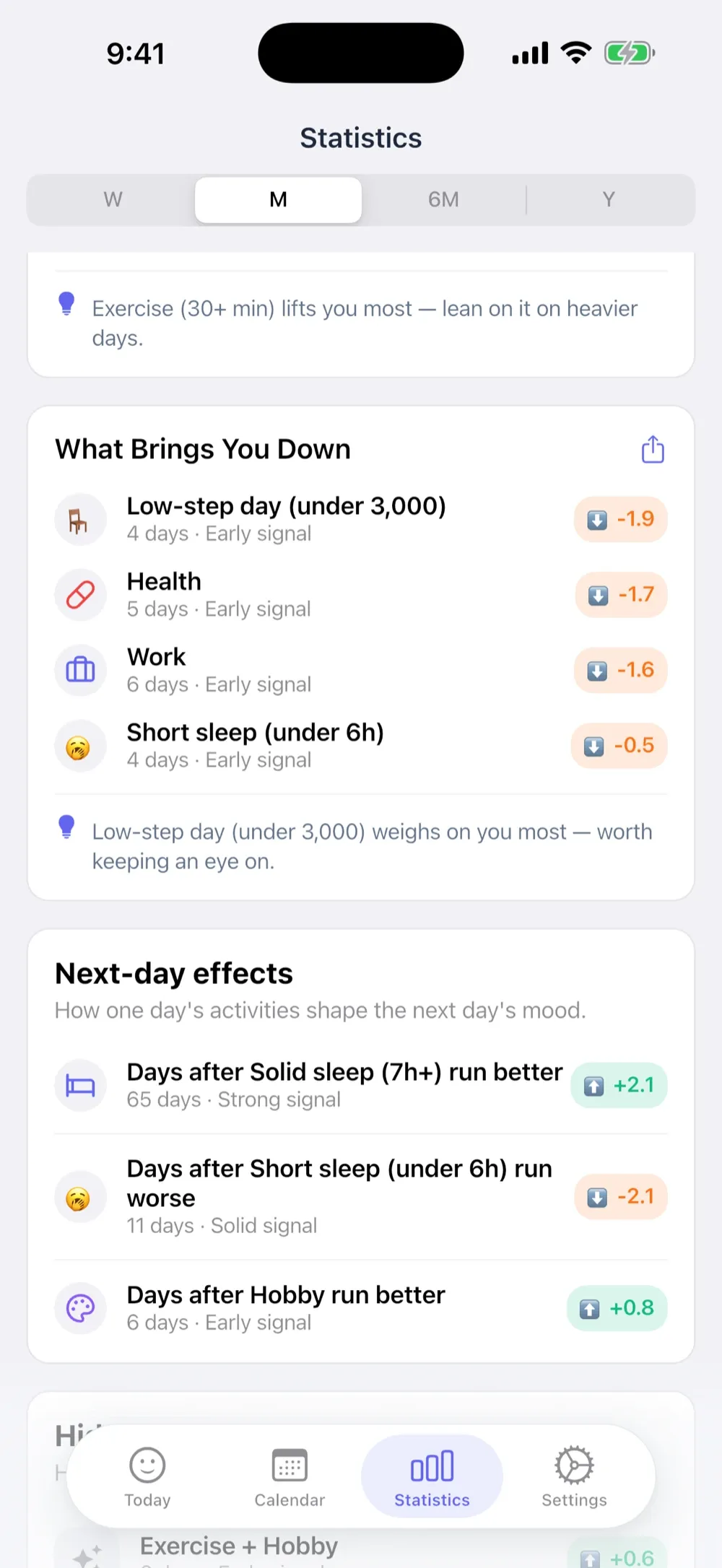
After about 14 entries, MoodKit’s Impact Leaderboard ranks all of those by their measured effect on your mood, with day counts shown, and the “what drags you down” side is usually a short list. The mood triggers guide explains how to read it without over-trusting a single bad day.
Then cut one input for a week
Once the ranking names a culprit, MoodKit’s skip-a-habit experiment tests it: drop that single input for seven days and get a verdict against your own baseline. Not “no news,” which nobody keeps in an election week, but “no feed,” or “no results checks after 9 p.m.” The narrower the cut, the more likely you keep it and the cleaner the answer. The self-experiments guide covers how the verdict is computed and why one week is enough to see a large effect.
The most useful of these, in our experience, is a next-day experiment on late-night checking. Results-night refreshing rarely ruins the evening; it ruins the following morning through sleep, which is why it hides from the same-day ranking. MoodKit reads last night’s sleep from Apple Health and ranks it alongside your tags, so the mechanism shows up as data instead of as a hunch.
The week of November 3
A short plan for the week itself, built on whatever the two weeks of data said. Keep the check-ins going; they take fifteen seconds and they’re the only way to know afterwards what the week actually did. Keep the one civic-action tag active, because doing something reliably ranks above watching in the data of most people who try this. Decide the results-night rule in advance (a time you stop checking) and tag whether you kept it. And schedule the phone-free walk, since it’s the closest thing to a control condition you have.
If you’re one of the 30% limiting time with family over politics, the tag “political chat” will tell you, in numbers, whether the conversations or the avoidance costs more. That’s a question worth answering with data rather than dread, and the answer is different for everyone.
MoodKit’s limits: it can’t see what you read or mute anything for you (no Screen Time integration), there’s no Apple Watch app, and the deeper insight cards are Premium after the free trial ($39.99 a year or $79.99 once; logging itself is free). What it does is the part the discourse never does: separate the election from the parts of the election that are actually getting to you.
Frequently asked questions
Is election stress a real condition?
"Election stress disorder" is a phrase therapist Steven Stosny coined in 2016, not a diagnosis. The stress it describes is real and common: in the APA's 2024 Stress in America survey, 69% of US adults called the presidential election a significant source of stress.
When are the 2026 midterm elections?
Tuesday, November 3, 2026, in the US, with early voting and mail ballots in the weeks before and results and recounts in the days after.
How do I stop election news from affecting my mood?
Measure first. Tag news, feeds, and political conversations in a mood tracker for two weeks and see which one actually moves you; most people find it's one source, not "the news." Then cut that one source for a week and check whether the mood follows.
Should I avoid talking politics with family?
Only your own data can answer that. In the 2024 APA survey, 32% of adults said politics had strained a family relationship and 30% limited time with family over values. Tagging those conversations shows whether they cost you, and how much.
Keep reading

Does Doomscrolling Wreck Your Mood? Run the One-Week Test
Brain-rot research says the feed is costing you. Your own data can say how much: a tag, two weeks of logs, and a skip-week experiment settle it.
· 3 min read

Nervous System Regulation: Prove Your Practice Works
Breathwork, cold plunges, somatic resets: wellness's biggest 2026 trend is easy to start and hard to evaluate. A mood log turns it into a fair test.
· 3 min read
How to Find Your Mood Triggers (With Data, Not Guesswork)
A practical method for identifying what really sets off your bad days: build a suspect list, log context for two weeks, read the patterns, then test one change.
· 3 min read